


Our group participated in large numbers and in a remarkably diverse range of activities at EGU26 (https://www.egu26.eu/), organized by the European Geosciences Union in Vienna, as tradition dictates, between May 3–8, 2026. This clearly reflects the active and multifaceted work of our group.
Altogether, our group members contributed to EGU26 with 3 session-organizing roles, 2 oral presentations, 2 poster presentations, 1 award, and 1 additional scientific-organizational activity.
We thank all members of our group for their participation and for presenting our results on an international platform. Keep up the great work!
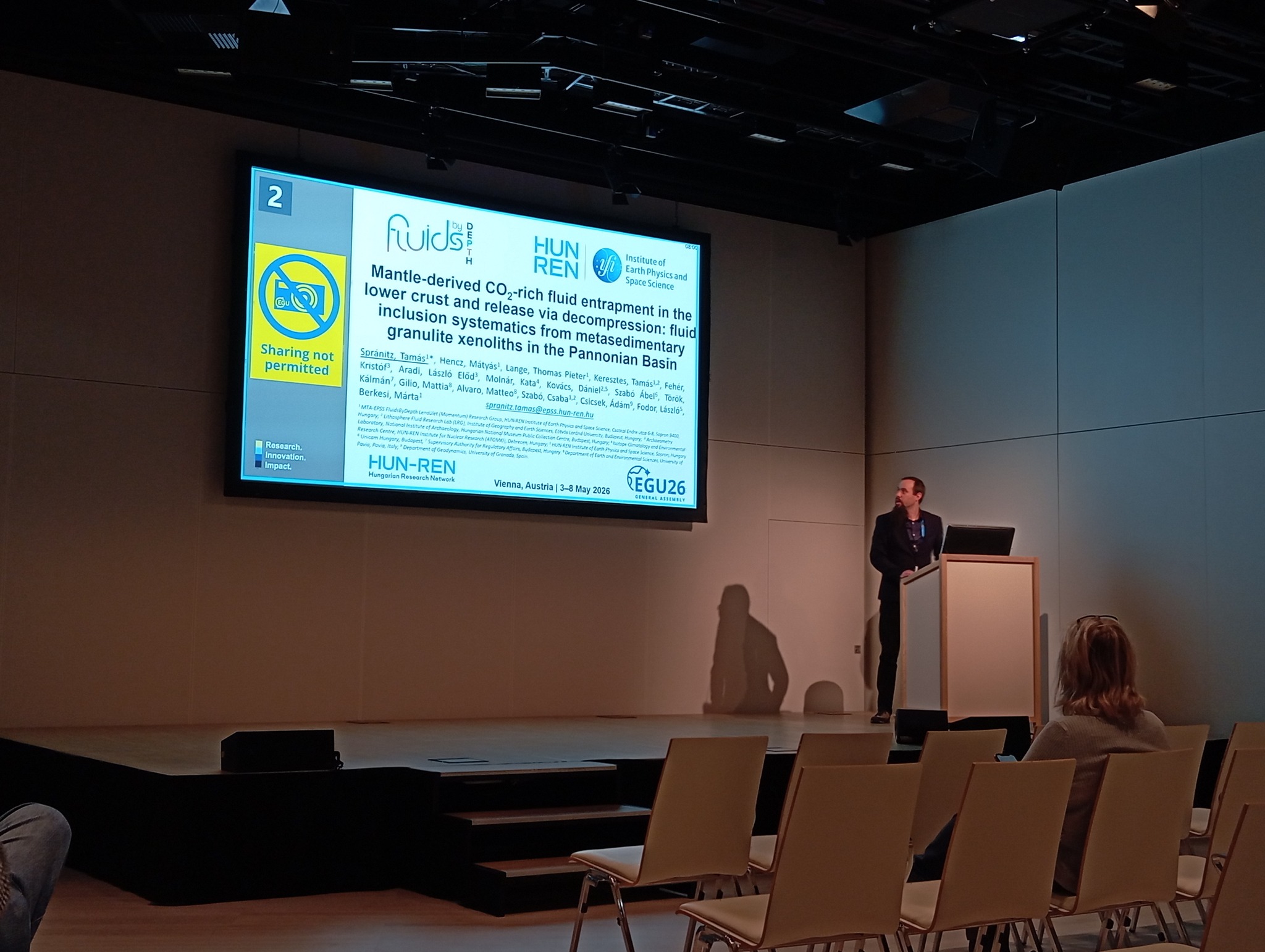
Tamás Spránitz gave a presentation on the research group’s latest fluid inclusion results from lower-crustal rocks and their key implications, entitled “Mantle-derived CO₂-rich fluid entrapment in the lower crust and release via decompression: fluid inclusion systematics from metasedimentary granulite xenoliths in the Pannonian Basin”, in the session “What Makes Earth So Special: Global Cycles of Volatiles”.
In addition to his presentation, Tamás also co-organized a new session dedicated to fluid/melt/crystal inclusion research. The invited speaker of the session, Prof. Bob Bodnar from Virginia Tech, USA, gave a fascinating and highly engaging presentation on fluid inclusion studies of meteorites. The session, entitled “Looking into the unreachable: Inclusions as snapshots into Earth processes, from the Crust to the deep Mantle and beyond”, aims to provide a European platform for the inclusion research community in the coming years, alongside the ECROFI meetings.
Kristóf Porkoláb gave a presentation on one of the research group’s recently published papers (https://www.nature.com/articles/s41598-026-43790-4) in the session “Chemistry, microstructures, and mineral physics: constraining crustal dynamics across scales”. His talk, entitled “Rheological and tectonic consequences of garnet breakdown in the lower crust: a case from the Pannonian Basin”, explored model-based links between lower-crustal instability, lithospheric weakening, and fluid flow.
Kristóf also received the prestigious Flinn-Hart Award of the International Lithosphere Program at EGU, in recognition of his outstanding research activity. We warmly congratulate him once again!
Tibor Rubóczki presented the latest results of geophysical research in the Bakony–Balaton Highland in the “Electromagnetic Induction in Geophysics (EMRP2.3)” session. His poster presentation was entitled “Analysis of Magnetotelluric and Gravity Anomaly Datasets in the Bakony-Balaton Highland Volcanic Field”. Our research combines state-of-the-art 3D gravity anomaly modelling and 3D magnetotelluric inversion methods, contributing to a more detailed understanding of the region’s complex crustal and lithospheric structure, as well as its geological and geochemical characteristics, including possible fluid flow processes.
Eszter Békési presented a poster at EGU on the numerical modelling of deep closed-loop geothermal systems, entitled “The effect of depth, temperature and pressure dependency of rock thermal properties on the performance of deep borehole heat exchangers: example from the Pannonian Basin”, in the session “Geothermal Systems in the Urban Energy Transition: Scientific, Engineering, and Integration Perspectives”. She was also active at the conference as co-organizer of the session “Soft rocks and Brittle rocks: comparison of geomechanics and insights for the Energy Transition”.
Márta Berkesi served as a session co-organizer for the third time in the session “Solving geoscience problems using mineralogy and minerals’ inclusions”. In addition, as a member of the Council of the European Association of Geochemistry (EAG), Márta organized an event for students and early-career researchers at the EAG booth, where she presented the EAG’s support activities and funding opportunities for students and postdoctoral researchers, and also welcomed ideas from visitors.
